Key points
- Bolt Graphics successfully powered on a 12nm test chip for its Zeus GPU project in mid-October.
- The company is seeking approximately $100 million in funding at a valuation near $700 million.
- Volume production of the final Zeus GPU is not expected until 2028.
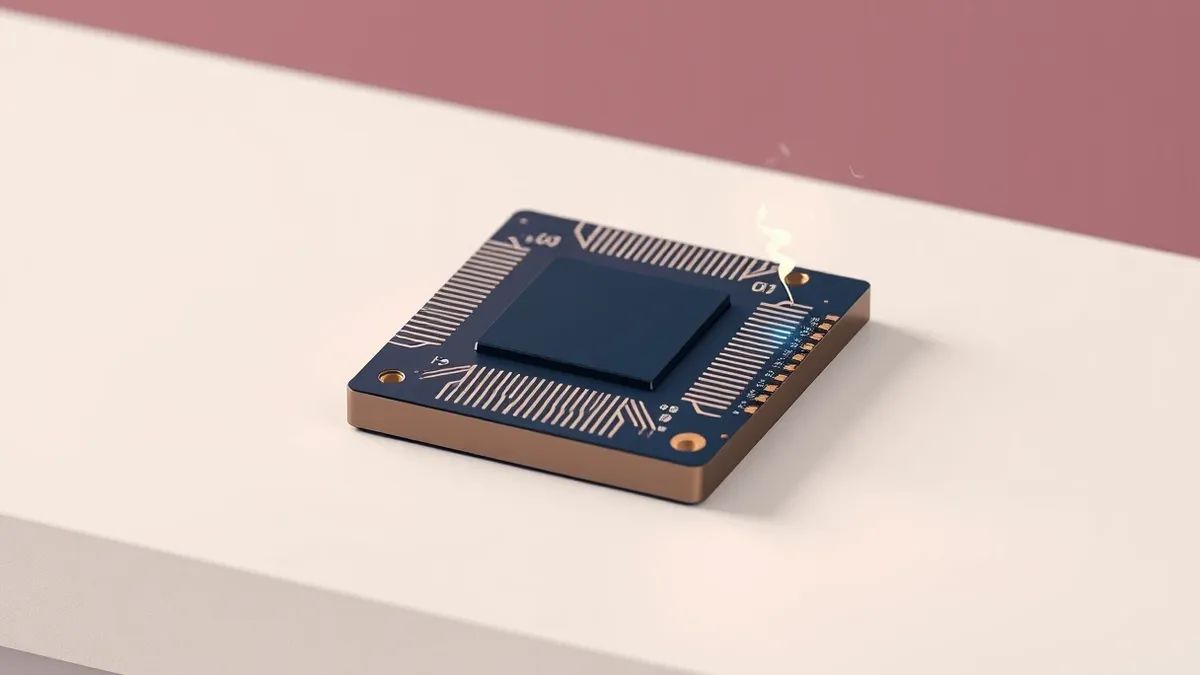
In mid-October, Bolt Graphics stated that its 12nm test chip for the Zeus GPU project activated successfully.reported The California-based startup stated that the silicon, manufactured by TSMC, ran fine during initial tests.Bolt Graphics turned on a small test chip for its new Zeus GPU, confirming the design works before mass production.Bolt Graphics validated its 12nm Zeus GPU test silicon, which draws 1.4 watts, ahead of a 2028 volume production target on TSMC's N5P node. The successful test run validates the design's core operation prior to volume manufacturing.
The figures
The test chip occupies 6 square millimeters and consumes 1.4 watts.reported This is a significant reduction from the 35 watts consumed by the field-programmable gate array used for previous prototyping.reported According to Reuters, Bolt is seeking to raise approximately $100 million at a valuation of roughly $700 million.reported The company plans to use TSMC's N5P process node for the final chip.
Behind the figures
The power draw comparison comes from Bolt's own testing against its previous FPGA-based prototypes. The valuation and funding figures were reported by Reuters based on three sources familiar with the matter.unverified Bolt has not published independent performance benchmarks for the test chip, only stating it beat internal estimates. The N5P process selection was made to avoid competition for limited wafer supplies.
The takeaway
The successful test run validates Bolt's ability to run complex physics algorithms in hardware, according to the published report The company opened a Taipei office to stay close to manufacturing partners ahead of production.reported The final Zeus GPU will be a separate chip from the test silicon, designed for electromagnetic simulation and rendering tasks.
The open questions
Bolt asserts that the upcoming Zeus GPU will offer rendering performance ten times greater than current GPUs and accelerate electromagnetic simulation by a factor of 300.reported The company asserts that Zeus can deliver path tracing throughput up to ten times that of Nvidia's RTX 5090.reported These performance claims have not been independently tested or verified by third parties. The company has not released specific performance data for the current test chip beyond beating internal estimates.
Why it matters
- Enterprise IT buyers can monitor Bolt's progress as a potential alternative for specialized electromagnetic simulation workloads.
- The planned 2028 volume production timeline indicates this technology is not yet available for immediate procurement or integration.
- The use of RISC-V cores and open-standard instruction sets may appeal to organizations seeking vendor-neutral hardware architectures.
- The memory expansion capability up to 384GB via DDR5 SO-DIMM slots could benefit large-scale simulation environments requiring high memory capacity.
Topics: Bolt Graphics, GPU, TSMC, RISC-V, electromagnetic simulation
Updated
Then / now / next
Bolt Graphics used a 35-watt FPGA for prototyping its Zeus GPU design.
The company has successfully powered on a 1.4-watt 12nm test chip.
Volume production of the final Zeus GPU is targeted for 2028.
Story timeline
- Then Bolt Graphics used a 35-watt FPGA for prototyping its Zeus GPU design.
- 31 Oct 2026 Bolt Graphics powers on its first Zeus GPU
- Now The company has successfully powered on a 1.4-watt 12nm test chip.
- Next Volume production of the final Zeus GPU is targeted for 2028.
The strongest doubt
Counterpoint from the sources
The performance claims for the future Zeus GPU have not been independently tested or verified by third parties.
Numbers in context
Circle area is proportional to the magnitude; labels retain signs. Figures may describe different measures. Read their contexts above.Ask the article
Local keyword search of this article; no generated answers.Did this article give you the evidence you needed?
Your choice stays on this device. No public tally.Questions readers ask
When will Bolt Graphics' Zeus GPU be available for purchase?
Volume production is not expected until 2028, according to the company's timeline.
What process node will the final Zeus GPU use?
The production Zeus GPU will utilize TSMC's N5P process node.
Has Bolt Graphics published independent performance benchmarks?
Bolt has not released performance data for the test chip.
Reading receipt
- Bolt Graphics successfully powered on a 12nm test chip for its Zeus GPU project in mid-October.
- The company is seeking approximately $100 million in funding at a valuation near $700 million.
- Volume production of the final Zeus GPU is not expected until 2028.